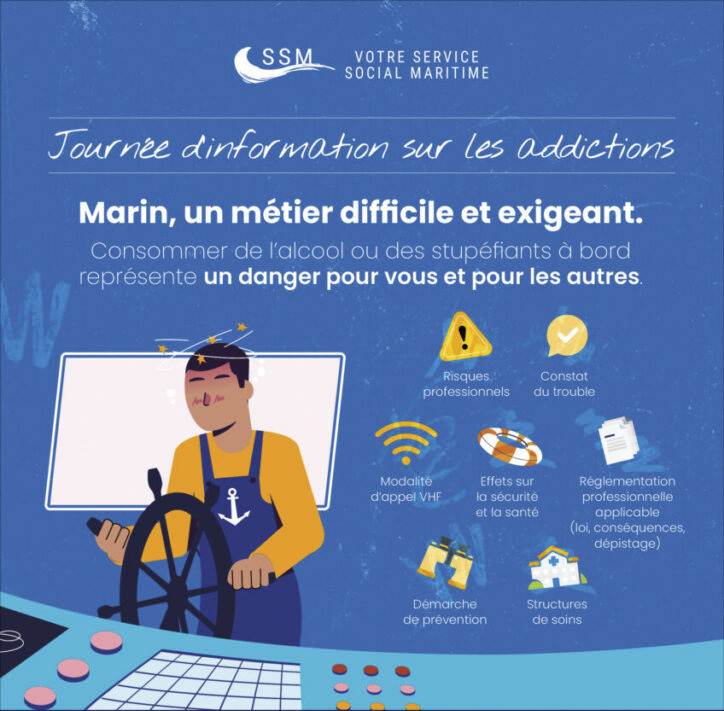
The Maritime Social Service (Service Social Maritime, SSM) in France has launched its first addiction awareness campaign aimed specifically at professionals working at sea. During September, the organisation brought three information days directly to fishing ports in Normandy, starting in Granville on 4 September, followed by Port-en-Bessin on 11 September and Saint-Vaast-la-Hougue on 18 September. The free events were designed to give seafarers, employers and colleagues an informal and confidential opportunity to ask questions about alcohol and drug use, discuss concerns and learn how to respond when problems arise at sea.
A central part of the campaign was practical and interactive prevention. Participants could use simulation goggles to experience how alcohol and drugs can affect vision, coordination and reactions, take part in knowledge tests and self-assessment exercises, and speak directly with professionals. The SSM also provided practical guidance on what to do when a crew member shows signs of impairment, including procedures for responding to behavioural problems and making emergency communications. The aim was deliberately non-stigmatising, recognising that alcohol and drug problems can affect people in any profession while focusing on the particular safety risks of working at sea.
The campaign also produced three awareness videos explaining the consequences of alcohol and drug use in the maritime workplace. They address alcohol consumption, drug use and the shared responsibilities of crew members, captains and shipowners. At sea, impairment can have consequences far beyond the individual because a reduction in judgement, coordination or alertness may put the entire crew at risk. The materials therefore combine information about health and safety with guidance on legal responsibilities and procedures when alcohol or drug use is suspected.
Speaking to France 3 Normandie during the Granville event, SSM director Rémi Pain stressed that the campaign is about prevention rather than labelling seafarers as people with addiction problems. Reliable data on the extent of alcohol and drug use aboard fishing vessels are limited, and people currently working in the sector may be reluctant to discuss the issue openly. By bringing practical information directly to ports, using interactive tools and offering confidential conversations, the campaign provides an example of how occupational addiction prevention can be made accessible to a workforce operating in a particularly demanding and safety-sensitive environment.
Find more from Service Social Maritime (SSM) (France, September 2026)

