Psychologists from the Konstanz Cluster of Excellence “Collective Behaviour” are using portable EEG technology to assess the impact of public video campaigns aimed at reducing risky alcohol consumption.
Public health campaigns are essential tools for promoting well-being and preventing harmful behaviors, such as drug abuse or the spread of infections during pandemics. A recent example is the World Health Organization’s (WHO) “Redefine Alcohol” campaign, launched in October 2024, which urges Europeans to reconsider the health risks associated with alcohol consumption. According to WHO, alcohol is directly responsible for one in eleven deaths in the region.
However, not all health campaigns succeed in changing behavior. To address this, psychologists Harald Schupp and Britta Renner from the University of Konstanz are exploring objective methods to evaluate campaign effectiveness during their development phase. Their research focuses on measuring viewers’ brain activity while watching anti-alcohol video messages.
Previous laboratory studies using functional magnetic resonance imaging (fMRI) and electroencephalography (EEG) demonstrated that strong health messages elicit synchronized brain activity among viewers, particularly in areas related to attention, emotions, and personal relevance.
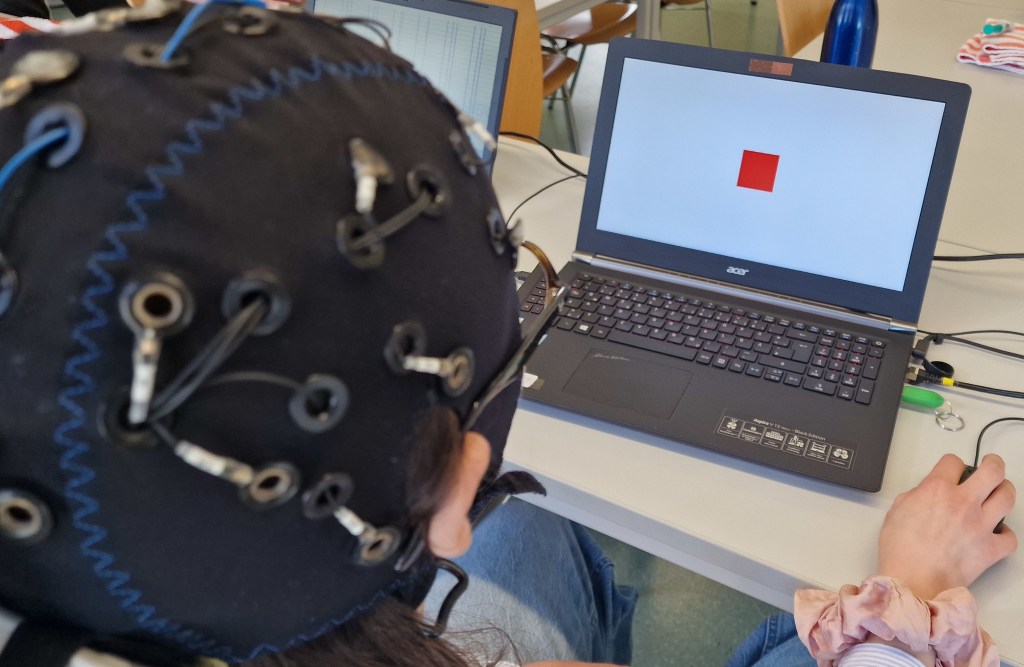
In a recent study, the Konstanz team advanced this research by employing portable EEGs in a standard seminar room, outside the controlled environment of a laboratory. They recorded the brain waves of multiple participants simultaneously and found that effective anti-alcohol messages still generated synchronized brain activity under these real-world conditions.
According to Schupp, this innovation makes the method more practical for public health applications. Portable EEG studies in small focus groups could support evidence-based selection of campaign materials, ensuring greater impact.
The research, published in Social Cognitive and Affective Neuroscience, highlights the potential of neural measures as a complement to traditional surveys in health psychology. The study received funding from the German Research Foundation and the Messmer Foundation.
Find more from Universität Konstanz (Germany, February 2025)
This video is a conceptual visualization of what brain synchronization looks like in people watching the same movie. In this case, people are watching a real-life alcohol risk video and their brains are scanned by fMRI to reveal dynamic fluctuations of brain activity. Each of the two brains represents the brain activity of one half of the audience. Blue to red color shows how the average brain activity of half of the group increases (red) or decreases (blue). Regions that show concurring increases or decreases of activity at the same time for both halves of the group can be assumed to show brain-to-brain coupling. While watching the dynamic video, visual regions in the back of the brain are especially “in tune” and show a high similarity as represented by concurring increases and decreases on both brains.
 Alcohol Awareness